Pheochromocytoma
Pheochromocytoma
Case presentation
50M with T1DM, chronic inflammatory demyelinating polyneuritis (monthly IVIG), CKD4, pheochromocytoma 2016 s/p resection, presenting for a second opinion for recently discovered metastatic disease.
- 2014-xx-xx ~50lb weight loss, recurrent diaphoresis and feeling of being hot, extreme fatigue
- 2014-06-xx presented to OSH
- 2014-06-15 10.2x9.0x6.8 cm mass on CTAP, taken to surgery. L adrenalectomy, L partial nephrectomy, splenectomy. Clean margins. 7 LN w/o cancer. Path: mostly necrotic tissue, low Ki-67 (specifics not available).
Case presentation
- 2021-08-xx plasma normetanephrine elevated
- 2021-09-xx PET dotatate: 1.8cm nodule in surgical bed, multiple b/l pulm nodules, LN: [paraaortic RP, mediastinal].
Told to get his affairs in order, consult to VUMC entered.
Case presentation
Labs
- Cr 2.75 (b/l)
- plasma normetanephrine 990
- plasma metanephrine <10
- otherwise bland
Exam
- SBP 140s, at baseline
- nothing else of note
Questions
- How common is pheochromocytoma/paraganglioma?
- sites of disease?
- symptoms?
- Is there a link between autoimmunity and pheo/para?
- Answer: not a robust one.
- After initial management, what should surveillance look like?
- labs?
- imaging?
- How should we think about prognosis?
- When should we treat?
- What treatment modalities are available?
- Any notable differences wrt other NETs?
Terminology
Pheochromocytoma
Neuroendocrine tumors arising from chromaffin cells of the adrenal medulla (usually, "pheochromocytoma" refers specifically to adrenal tumors).
Paraganglioma
Same idea, paraganglia NET, but not adrenal (chromaffin staining usually less robust).
PPGL
Catch-all term ("pheochromocytoma and paraganglioma") Different papers use different acronyms for the same thing.
Terminology
Malignant PPGL
Determined by:
imagingpathologymutations
"Malignancy can only be determined from the presence of metastatic lesions at sites where chromaffin cells are normally absent."1 Proven by bx, functional imaging and catecholamines can also be helpful.
Terminology
Metastatic, Recurrent, Synchronous
Metastatic: wrong place (bone ~60%, distant LN ~40%, lung ~30%, liver ~25%)
Synchronous: multiple right places (sympathetic trunk, H&N)
Recurrent: right place, again
Epidemiology
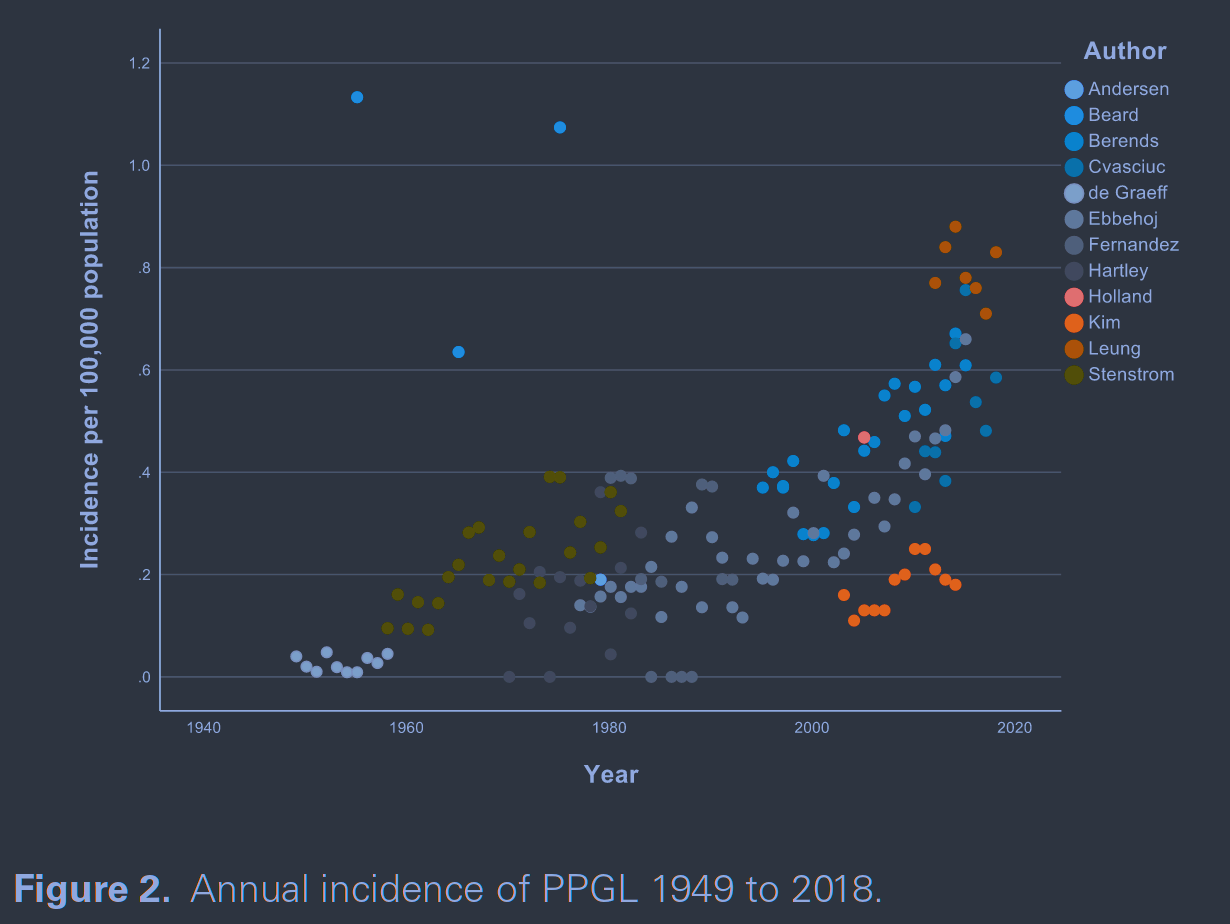
- Detected incidence for PPGL: 0.6/100k, rising with time
- ~0.5% of all pts with HTN
- ~4% in adrenal incidentaloma
- >35% of cases are associated w germline mutations
- ~2/3-3/4 p/w with hormone-related sx, ~2/3-3/4 p/w with tumor-related sx
Surveillance
Type and frequency depends on low- vs high-risk status.
High-risk features
- tumor size >=5cm
- any paragangliomata (extra-adrenal)
- SDHx mutation
- plasma methoxytyramine >=3x ULN
If low-risk
- metanephrines 2-6wk s/p surgery, then dealer's choice (usu yearly)
- image if metanephrines get out of whack
If high-risk
- metanephrines and imaging, at least yearly
- dotatate vs FDG
Prognosis
If malignant1
- 5y OS ~60-80%
- PPGL-attributable death 85%
- Modes of death?
- Poor prognostic factors: sporadic disease, hypersecretion
- Favorable prognostic factors: H&N disease, SDHx mutation (availability of drugs, usu younger, more often H&N locale, less likely to be hypersecretors)
If benign2
- 5y OS >95%
Management
Observation
- most of the time, surveil closely after initial resection (if it was done)
Active
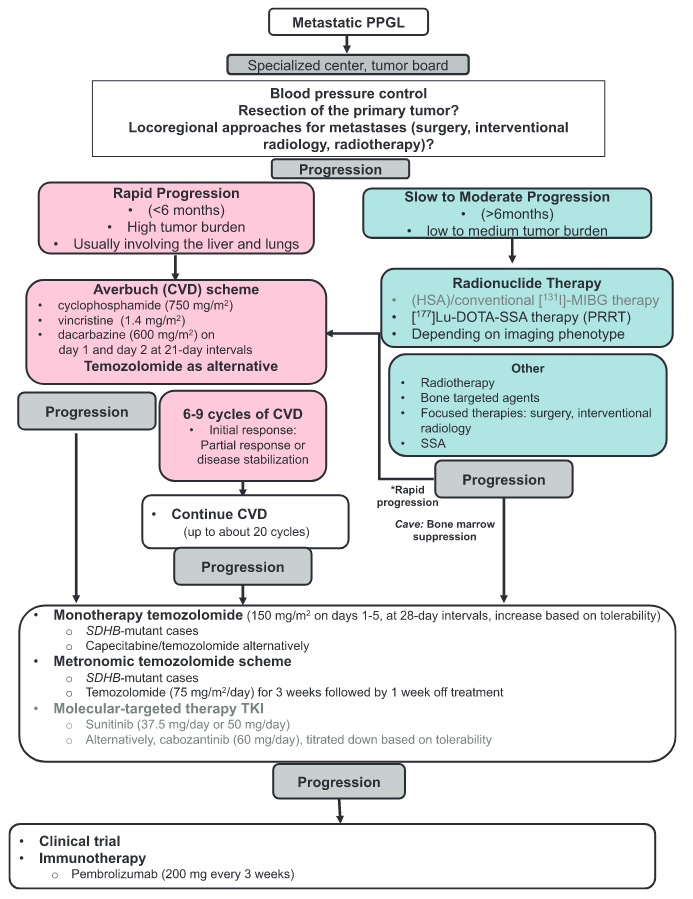
- next slide
Resources
Bibliography
- Al Subhi, Abdul Rahman, Veronica Boyle, and Marianne S. Elston. "Systematic Review: Incidence of Pheochromocytoma and Paraganglioma Over 70 Years." Journal of the Endocrine Society 6, no. 9 (September 1, 2022): bvac105. https://doi.org/10.1210/jendso/bvac105.
- De Filpo, G., G. Cantini, G. Rastrelli, G. Vannini, T. Ercolino, M. Luconi, M. Mannelli, M. Maggi, and L. Canu. "Management and Outcome of Metastatic Pheochromocytomas/Paragangliomas: A Monocentric Experience." Journal of Endocrinological Investigation 45, no. 1 (January 1, 2022): 149–57. https://doi.org/10.1007/s40618-021-01629-x.
- Else, Tobias. "15 YEARS OF PARAGANGLIOMA: Pheochromocytoma, Paraganglioma and Genetic Syndromes: A Historical Perspective." Endocrine-Related Cancer 22, no. 4 (August 1, 2015): T147–59. https://doi.org/10.1530/ERC-15-0221.
- Fassnacht, M., G. Assie, E. Baudin, G. Eisenhofer, C. de la Fouchardiere, H. R. Haak, R. de Krijger, F. Porpiglia, M. Terzolo, and A. Berruti. "Adrenocortical Carcinomas and Malignant Phaeochromocytomas: ESMO–EURACAN Clinical Practice Guidelines for Diagnosis, Treatment and Follow-Up†." Annals of Oncology 31, no. 11 (November 1, 2020): 1476–90. https://doi.org/10.1016/j.annonc.2020.08.2099.
- Fishbein, Lauren, Jaydira Del Rivero, Tobias Else, James R. Howe, Sylvia L. Asa, Debbie L. Cohen, Patricia L. M. Dahia, et al. "The North American Neuroendocrine Tumor Society Consensus Guidelines for Surveillance and Management of Metastatic and/or Unresectable Pheochromocytoma and Paraganglioma." Pancreas 50, no. 4 (April 2021): 469–93. https://doi.org/10.1097/MPA.0000000000001792.
- Garcia-Carbonero, R., F. Matute Teresa, E. Mercader-Cidoncha, M. Mitjavila-Casanovas, M. Robledo, I. Tena, C. Alvarez-Escola, et al. "Multidisciplinary Practice Guidelines for the Diagnosis, Genetic Counseling and Treatment of Pheochromocytomas and Paragangliomas." Clinical & Translational Oncology: Official Publication of the Federation of Spanish Oncology Societies and of the National Cancer Institute of Mexico 23, no. 10 (October 2021): 1995–2019. https://doi.org/10.1007/s12094-021-02622-9.
- Hamidi, Oksana. "Metastatic Pheochromocytoma and Paraganglioma: Recent Advances in Prognosis and Management." Current Opinion in Endocrinology, Diabetes & Obesity 26, no. 3 (June 2019): 146–54. https://doi.org/10.1097/MED.0000000000000476.
- Hescot, Segolene, Maria Curras-Freixes, Timo Deutschbein, Anouk van Berkel, Delphine Vezzosi, Laurence Amar, Christelle de la Fouchardière, et al. "Prognosis of Malignant Pheochromocytoma and Paraganglioma (MAPP-Prono Study): A European Network for the Study of Adrenal Tumors Retrospective Study." The Journal of Clinical Endocrinology & Metabolism 104, no. 6 (June 1, 2019): 2367–74. https://doi.org/10.1210/jc.2018-01968.
- Kim, Jung Hee, Hyemi Moon, Junghyun Noh, Juneyoung Lee, and Sin Gon Kim. "Epidemiology and Prognosis of Pheochromocytoma/Paraganglioma in Korea: A Nationwide Study Based on the National Health Insurance Service." Endocrinology and Metabolism (Seoul, Korea) 35, no. 1 (March 2020): 157–64. https://doi.org/10.3803/EnM.2020.35.1.157.
- Nölting, Svenja, Nicole Bechmann, David Taieb, Felix Beuschlein, Martin Fassnacht, Matthias Kroiss, Graeme Eisenhofer, Ashley Grossman, and Karel Pacak. "Personalized Management of Pheochromocytoma and Paraganglioma." Endocrine Reviews 43, no. 2 (March 9, 2022): 199–239. https://doi.org/10.1210/endrev/bnab019.