Anaplastic Thyroid Carcinoma
Anaplastic Thyroid Carcinoma
Anaplastic Thyroid Carcinoma
Case presentation
73M w CAD (MI x1, no interventions), T2DM (not on insulin), hx smoking (0.3 ppd x 45y, quit 10y ago), p/w 50lb weight loss, dysphagia, ~4mo enlarging neck mass, found to have AKI and large neck mass on imaging.
TImeline
- 2022-04 intermittent sinus issues began, multiple courses of abx, voice hoarse
- 2022-07-12 PCP visit: noted 36lb weight loss since January. Dysphagia at times. Left face hurts when he lies down. Nontender thryomegaly present on exam. TSH 7.14
- 2022-07-13 US thyroid: left lobe heterogenous and 6.8x5.6x4.4 (R lobe 3.4x1.3x1.4)
- 2022-08-14 presented to VUMC
Case presentation
Timeline
- 2022-08-15 FNA: ATC vs PDTC, but need more tissue for confirmation and ancillary testing
- 2022-08-19 Core bx:
- Gross: Sections show an infiltrative malignant neoplasm composed primarily of plump, epithelioid and spindle cells with pleomorphic nuclei, mitotic activity, and background acute and chronic inflammation. In this tumor component, there is no appreciable nesting, squamous, glandular, or other differentiation. There is, however, a focus of a more well-differentiated neoplasm in nests, cords, and small follicles, a few with colloid, which is morphologically consistent with a follicular neoplasm.
- IHC: +PAX-8 (nested foci and spindled component strong and extensive) and TTF-1 (nested foci strong and extensive and spindled component more focal). The nested foci are strongly and extensively positive for cytokeratins AE1/AE3 and 8/18 while the spindled component is negative for both cytokeratins.
- 2022-08-21 BRAF PCR: + for c.1799T>A (p. V600E)
Case presentation
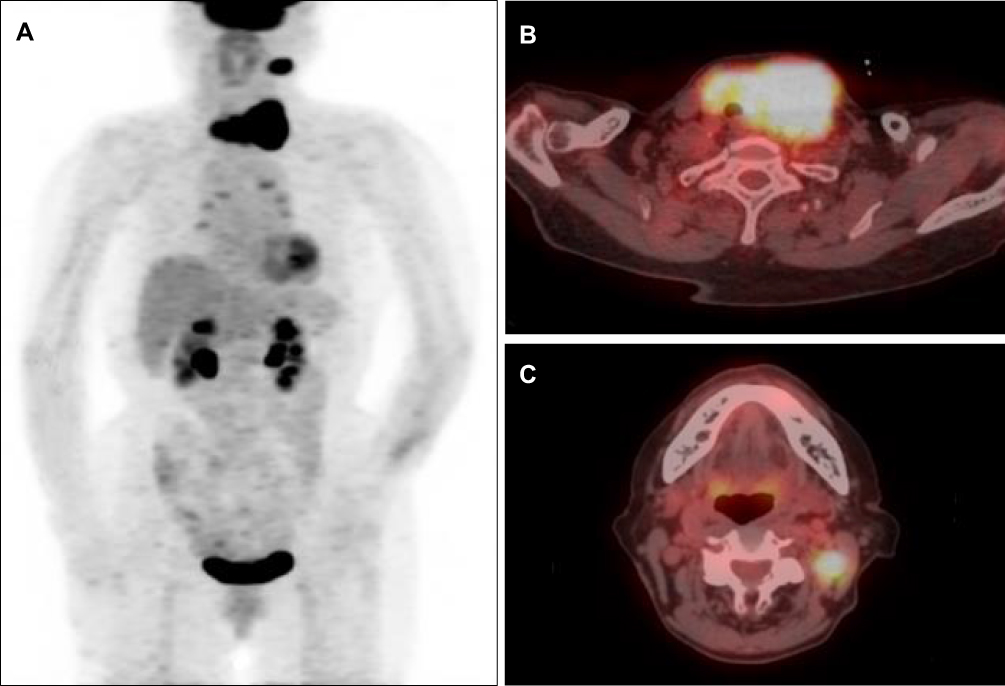
CT neck with large left-sided thyroid mass, FDG-PET concordant, with some focal pulmonary avidity.
Case presentation
Tumor board
- Surgery: not a surgical candidate (mostly tumor factors)
- RT: planned
- Med onc: let's talk
And then...
- PEG placed
- many discussions w primary, med onc, family
- home w hospice
- died at home 3mo later
- ~11mo from first sx (weight loss)
- ~6mo from notable thyroid mass
- ~4mo from tissue dx
Questions
- What is ATC?
- Why is it so gnarly?
- What is the prognosis?
- What are the key details of workup that change management?
- What kind of imaging should we get?
- Do we need to ask for anything special from pathology?
- How was it managed classically?
- How is it managed in the modern era?
- What is the role of surgery?
- What is the role of RT?
- What is the role of systemic (chemo/immuno/small molecule) therapy?
Epidemiology1
- thyroid cancers in general:
- 2.5% of all cancers in the US
- 2009 incidence: 37,200
- 2009 death rate: 1,630
- ATC:
- 1-2% of all thyroid cancers in the US
- 0.12 per 100,000 person-years (SEER)
- total incidence rising over time (SEER)
- likely not just better screening or detection
Epidemiology
- some geographies have higher percent prevalence, up to 10%
- differences in percent prevalence appear to be largely driven by general healthcare disparities
- percent prevalence has fallen rapidly since the 1960s (25-35%)
- iodine
- fixing earlier-stage thyroid cancers
Epidemiology
- median OS: 3-6mo, median 1y survival: 20% (historically)
- accounts for up to 50% of deaths due to thyroid cancer
- general thyroid cancer 2009 incidence: 37,200
- general thyroid cancer 2009 death rate: 1,630
- ATC incidence: 2%
- ATC yearly death rate: near 100%
- 37000 * 0.02 = 740
Epidemiology
- male:female 1.5:2
- typically >60yo
- 30% have long-standing goiter, then rapid progression
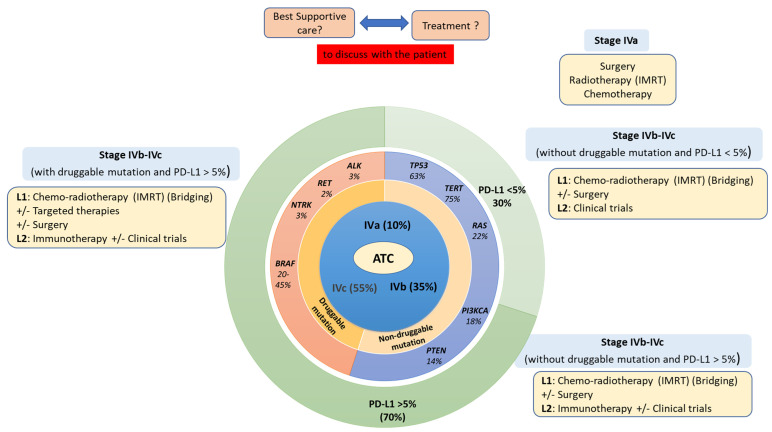
- IVa - localized - 10%
- IVb - locally advanced - 35%
- IVc - metastatic - 55% (lung, bone, liver, brain)
- Differentiated thyroid cancer (DTC) component or hx of DTC in 58-90% of cases
Overview (WHO Criteria changed in 2022)
| High Grade and Anaplastic Thyroid Carcinomas | |||
|---|---|---|---|
| Tumor type | High Grade Follicular Cell-Derived Thyroid Carcinomas (HGFCTC) | Anaplastic Thyroid Carcinoma (ATC) | |
| Differentiated High Grade Thyroid Carcinoma (DHGTC) | Poorly Differentiated Thyroid Carcinoma (PDTC) | ||
| WHO definition |
|
|
|
| IHC |
|
|
|
| Mutations |
|
|
|
| RAI avidity | 42% | 65% | No, but is avid on FDG-PET |
| Distant metastases (5y) | 48% | 60% | 75-80% |
| Disease-specific mortality (5y) | 32% | 30% | >80% |
Staging (AJCC 8th Edition)
All ATC is considered stage IV.
| T | N | M | |
| IVA | T1-T3a | N0/NX | M0 |
| IVB | T1-T3a | N1 | M0 |
| T3b | Any N | M0 | |
| T4 | Any N | M0 | |
| IVC | Any T | Any N | M1 |
Advanced T stages are defined by extrathyroidal invasion.
| T1a = ≤1cm | T3b = invading strap muscles only |
| T1b = >1cm - ≤2cm | T4a = invading beyond strap muscle |
| T2 = >2cm - ≤4cm | T4b = invading into prevertebral fascia, encasing carotid or mediastinal vessels |
| T3a = >4cm |
Management
Management continued - targets
- 70% PD-L1 ≥70%
- 73% TPS ≥5%
- 10-15% dMMR
- 20-45% BRAF (dabrafenib-trametinib1, vemurafenib, cobimetinib)
- 2-3% ALK (crizotinib, brigatinib, ceritinib)
- 2-3% NTRK (larotrectinib, entrectinib)
- 2-3% RET (selpercatinib, praseltinib)
- mKI - lenvatinib
Management continued - chemo +/- RT
- modest overall benefit, but can be started quickly
- typically taxane+platinum or doxorubicin+taxane/platinum
- most prefer regimens with weekly dosing given rapid doubling time
- e.g. carbo AUC2 + paclitaxel 50-100mg/m2
- there's no real data for this, very institution and provider specific
- involve RT early for consideration of chemo+RT
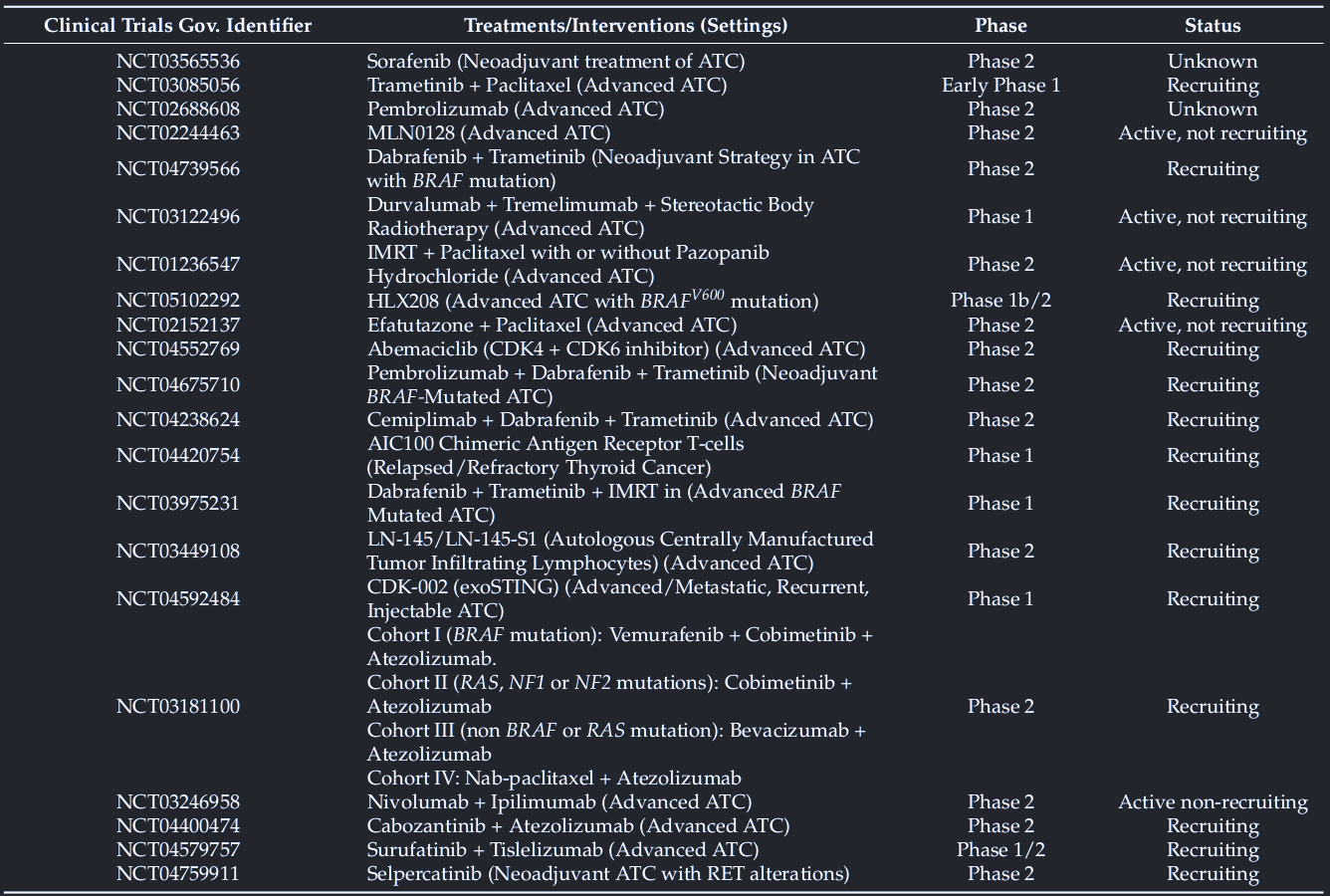
Ongoing trials (as of early 2023)
Key points
- ATC is universally fatal, but early targeted and multidisciplinary intervention can improve outcomes, including extending survival to years in some cases
- Call pathology, get BRAF IHC and/or PCR as fast as possible
- Even if the mgmt appears to be primarily surgical, involve H&N med onc specialist up front
- TKI+IO is an attractive option, but it can be difficult to get IO approved quickly enough to make a difference
- TKI can typically get approved quickly
- resection can be beneficial even in the metastatic setting, neoadjuvant therapies can increase the feasibility
Resources
Bibliography
- Sherman, E. J. et al. Radiotherapy and paclitaxel plus pazopanib or placebo in anaplastic thyroid cancer (NRG/RTOG 0912): a randomised, double-blind, placebo-controlled, multicentre, phase 2 trial. The Lancet Oncology 24, 175–186 (2023).
- Maurer, E. et al. Mutation-based, short-term ‘neoadjuvant’ treatment allows resectability in stage IVB and C anaplastic thyroid cancer. Eur Arch Otorhinolaryngol (2023) doi:10.1007/s00405-023-07827-y.
- Lorimer, C. et al. Dabrafenib and Trametinib Therapy for Advanced Anaplastic Thyroid Cancer - Real-World Outcomes From UK Centres. Clin Oncol (R Coll Radiol) 35, e60–e66 (2023).
- Jungels, C., Pita, J. M. & Costante, G. Anaplastic thyroid carcinoma: advances in molecular profiling and targeted therapy. Curr Opin Oncol 35, 1–9 (2023).
- Yuan, J. & Guo, Y. Targeted Therapy for Anaplastic Thyroid Carcinoma: Advances and Management. Cancers (Basel) 15, 179 (2022).
- Subbiah, V. et al. Dabrafenib plus trametinib in patients with BRAF V600E-mutant anaplastic thyroid cancer: updated analysis from the phase II ROAR basket study. Ann Oncol 33, 406–415 (2022).
- Ragusa, F. et al. Combination Strategies Involving Immune Checkpoint Inhibitors and Tyrosine Kinase or BRAF Inhibitors in Aggressive Thyroid Cancer. Int J Mol Sci 23, 5731 (2022).
- Luo, Y. et al. Immune Checkpoint Protein Expression Defines the Prognosis of Advanced Thyroid Carcinoma. Front Endocrinol (Lausanne) 13, 859013 (2022).
- Lee, J.-S. et al. Prognosis of Anaplastic Thyroid Cancer with Distant Metastasis. Cancers (Basel) 14, 5784 (2022).
- Jannin, A. et al. Anaplastic Thyroid Carcinoma: An Update. Cancers (Basel) 14, 1061 (2022).
- Huang, D., Zhang, J., Zheng, X. & Gao, M. Efficacy and Safety of Lenvatinib in Anaplastic Thyroid Carcinoma: A Meta-Analysis. Front Endocrinol (Lausanne) 13, 920857 (2022).
- Dong, W. et al. Conditional Survival Rate Estimates for Anaplastic Thyroid Cancer Beyond the First Year: An Analysis of SEER Data (2004 to 2019). Thyroid (2022) doi:10.1089/thy.2022.0339.
- Chen, Y. H. et al. Prior thyroid and non-thyroid cancer history do not significantly alter overall survival in patients diagnosed with anaplastic thyroid carcinoma. Thyroid (2022) doi:10.1089/thy.2022.0350.
- Xiang, J., Wang, Z., Sun, W. & Zhang, H. A relook at the 8th edition of the AJCC TNM staging system of anaplastic thyroid carcinoma: A SEER-based study. Clin Endocrinol (Oxf) 94, 700–710 (2021).
- Zhang, H., Zhao, Y.-C., Wu, Q., Wang, L. & Sun, S. The prognostic value of lymph node metastasis and the eighth edition of AJCC for patients with anaplastic thyroid cancer. Clin Endocrinol (Oxf) 95, 498–507 (2021).
- Rocha, M. L., Schmid, K. W. & Czapiewski, P. The prevalence of DNA microsatellite instability in anaplastic thyroid carcinoma - systematic review and discussion of current therapeutic options. Contemp Oncol (Pozn) 25, 213–223 (2021).
- Kim, H. J., Chang, H.-S. & Ryu, Y. H. Prognostic Role of Pre-Treatment [18F]FDG PET/CT in Patients with Anaplastic Thyroid Cancer. Cancers (Basel) 13, 4228 (2021).
- Abe, I. & Lam, A. K.-Y. Anaplastic thyroid carcinoma: Updates on WHO classification, clinicopathological features and staging. Histol Histopathol 36, 239–248 (2021).
- Maniakas, A. et al. Evaluation of Overall Survival in Patients With Anaplastic Thyroid Carcinoma, 2000-2019. JAMA Oncology 6, 1397–1404 (2020).
- Lin, B. et al. The incidence and survival analysis for anaplastic thyroid cancer: a SEER database analysis. Am J Transl Res 11, 5888–5896 (2019).
- Subbiah, V. et al. Dabrafenib and Trametinib Treatment in Patients With Locally Advanced or Metastatic BRAF V600-Mutant Anaplastic Thyroid Cancer. J Clin Oncol 36, 7–13 (2018).
- Ghossein, R. A., Katabi, N. & Fagin, J. A. Immunohistochemical detection of mutated BRAF V600E supports the clonal origin of BRAF-induced thyroid cancers along the spectrum of disease progression. J Clin Endocrinol Metab 98, E1414-1421 (2013).
- Thomas, C. G. & Buckwalter, J. A. Cancer of the thyroid. Adv Surg 10, 245–285 (1976).
- Smallridge, R. C. & Copland, J. A. Anaplastic thyroid carcinoma: pathogenesis and emerging therapies. Clin Oncol (R Coll Radiol) 22, 486–497 (2010).