Lower-Risk MDS
Lower-Risk MDS
Lower-Risk MDS
Case presentation
81M w CKD (b/l Cr 1.8), HFpEF (admitted 2x last year), AF (on apixaban), p/w hgb 10.1, MCV 99.
- Feels fine overall, some DoE that is longstanding, doing well since last admission and diuresis.
- No frequent infections.
- Doesn't have dentures, no OTC supps.
Case presentation
Labs
- hgb 10.1, MCV 99
- plt 132
- WBC 5.3, normal diff
- folate, B12 replete
- TSAT 19%
Case presentation
- Given 1g IV iron, seen back in 10wks, BMBx scheduled prophylactically
- hgb 9.6, MCV 97
- other counts unchanged
Case presentation
BMBx
- 35% cellularity
- blasts 1%
- dysplasia in 15% of erythroid precursors (megaloblastic erythroblasts, basophilic stippling, cytoplasmic vacuolation)
- no ringed sideroblasts
- del(5q)
- NGS pending
Questions
- How common is MDS?
- What do people present with?
- How do we risk-stratify MDS?
- What are the relative incidences of the risk strata?
- When do we intervene in lower-risk disease?
- What tools do we have?
- How do we sequence therapies?
- Can we impact prognosis?
Epidemiology
- yearly incidence: 4/100,0001
- incidence increases with age:2
- <40yo: 0.1/100,000
- >65yo: 25/100,000
- 70-79yo: 30/100,000
- >80yo: 60/100,000
- underreported: yearly incidence >65yo may be as high as 75/100,0003
- median age of dx: 70-75
- male predominance
- 5.4/100,000 vs 2.9/100,000 in women
- del(5q) more common in women (7:3)
- 75% are LR-MDS
S/sx prevalence (%)1
| Fatigue | 55 |
| Hgb <10 g/dL | 52 |
| Plt <100 x 109/L | 40 |
| ANC <800 x 109/L | 18 |
| Fever/infection | 15 |
| Bleeding | 8 |
Diagnosis
- ≥1 cytopenias
- hgb <10, ANC <1800, plt <100k
- ≥10% dysplastic cells in ≥1 lineage*
- <20% blasts
- presence of certain cytogenetic/molecular findings
- absence of AML-defining (cyto)genetics (e.g. t(8;21), CBFB-MYH11)
* if certain cytogenetic changes**, can dx MDS w/o dysplasia (<10% of cases)
** monosomy 5, 7, or 13; 5q, 7q, and 13q deletions; i(17p) and t(17p); 11q deletion; 9q or 12p deletion; or t(12p), idic (X)(q13)
Risk stratification
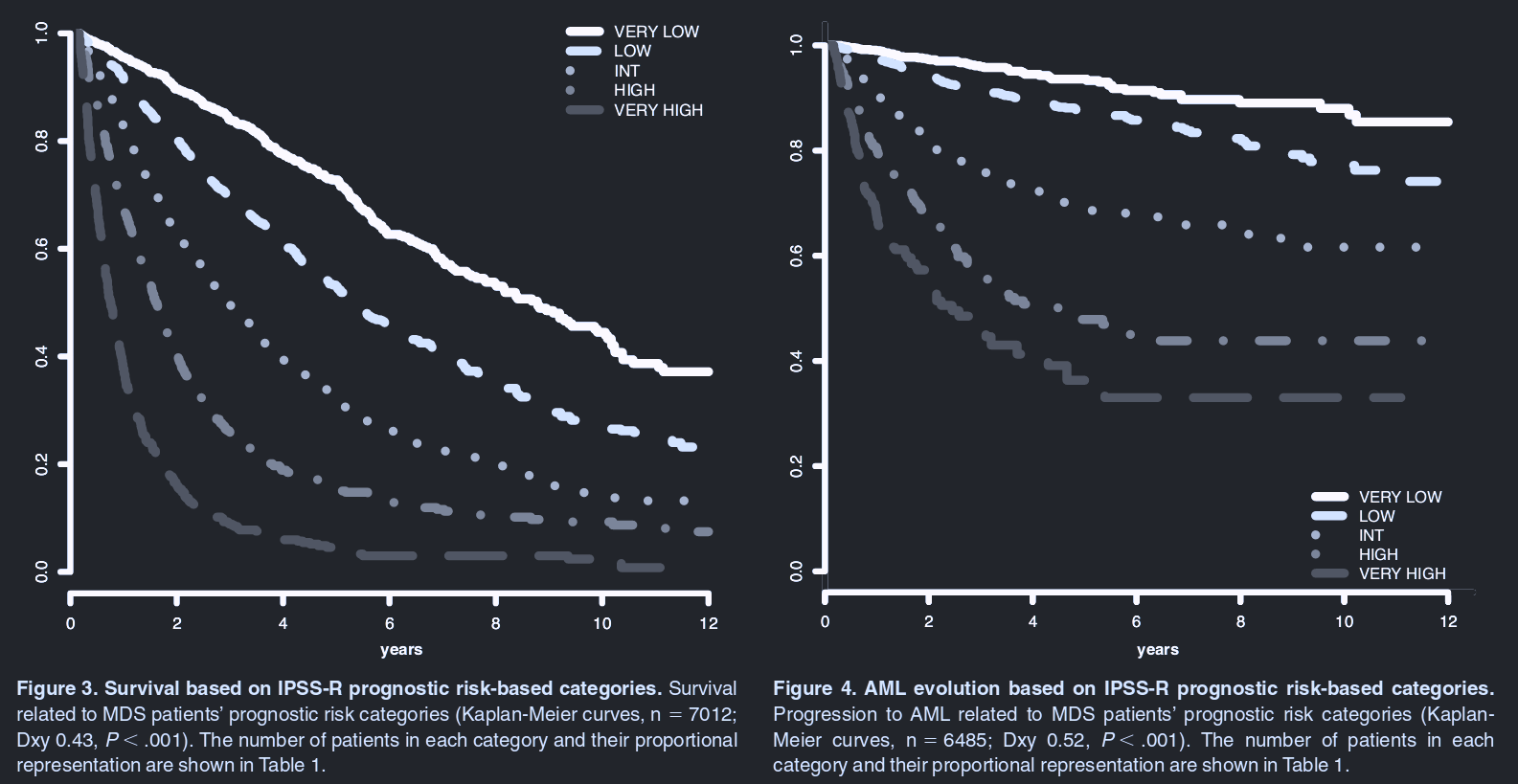
Risk stratification (IPSS)
| Variable | Score | ||||
| 0 | 0.5 | 1 | 1.5 | 2 | |
| Bone marrow blasts (percent) | <5 | 5-10 | - | 11-20 | 21-30 |
| Karyotype | Good | Intermediate | Poor | - | - |
| Cytopenias | 0-1 | 2-3 | - | - | - |
- Karyotype stratification:
- Good: Normal, -Y, del(5q), del(20q)
- Intermediate: not good nor poor
- Poor: ≥3 abnl, chromosome 7 abnl
Risk stratification (IPSS)
| Risk group | IPSS score |
| Low | 0 |
| Intermediate-1 | 0.5 to 1 |
| Intermediate-2 | 1.5 to 2 |
| High | 2.5 to 3.5 |
Risk stratification (IPSS-R)
| 0 | 0.5 | 1.0 | 1.5 | 2.0 | 3.0 | 4.0 | |
| blast % | ≤2 | >2 - <5 | 5 - 10 | >10 | |||
| hgb | ≥10 | 8 - <10 | <8 | ||||
| plt | ≥100 | 50 - 100 | <50 | ||||
| ANC | ≥0.8 | <0.8 | |||||
| cytogenetics | very good
-Y, del(11q) |
good
normal, del(12p), del(20q), del(5q), double w del(5q) |
intermediate
single NOS, del(7q), +8, +19, i(17q), double w/o del(5q) or -7/del(7q) |
poor
-7, double w -7/del(7q), inv(3)/t(3q)/del(3q), 3 abnl |
very poor
>3 abnl |
||
Risk stratification (IPSS-R)
| Risk group | IPSS-R score | ||
| very low | ≤1.5 | ||
| low | >1.5 to 3.0 | ||
| intermediate | >3 to 4.5 | ||
| high | >4.5 to 6 | ||
| very high | >6 |
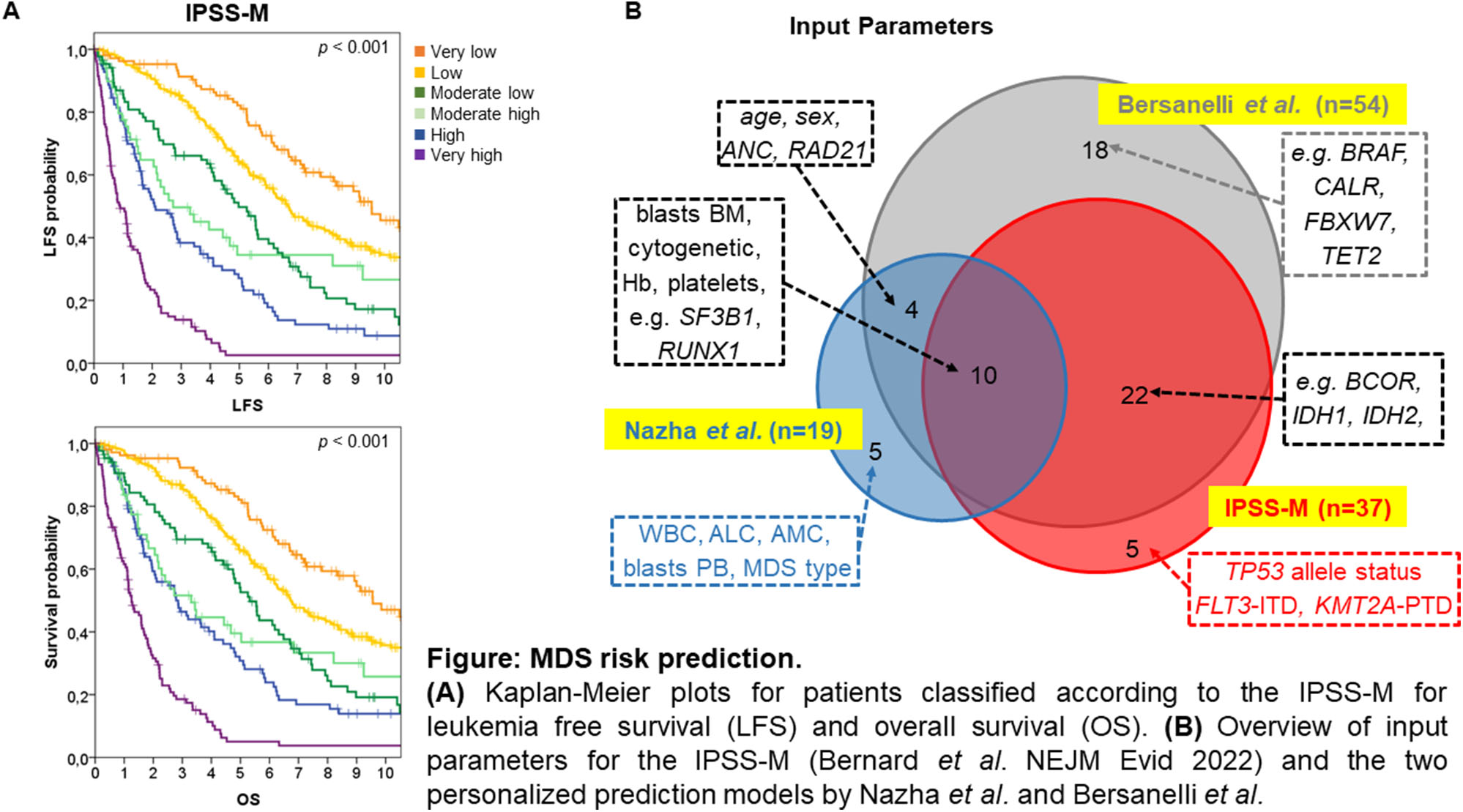
Risk stratification (IPSS-many)
Management
Goals of management
No interventions have been shown conclusively to improve OS in LR-MDS.1
- reduce sx
- reduce tfx dependence
- minimize morbidity
- balance tox of tx vs tox of dz
Management - anemia
EPO
- relatively high dose, e.g. 60,000u EPO q7d, 500 μg darbepoetin alfa q21d
- meta-analysis: ~40% response rate overall (hgb up 1-1.5g, reduction in tfx)
- 2017 RCT: 15% RR at 24wk (0% in placebo)
- Open-label 48wk f/u: 35% RR
- response rate is higher if lower baseline EPO (e.g.<200 IU/L)
- if high tfx dependence (≥1 tfx/14d) and EPO >200, RR <10%
- mean duration of response: 8-23mo
- fever in 10%
Management - anemia
luspatercept
- TGF-b superfamily, promotes late-stage erythropoeisis
- MDS-RS (usu SF3B1-mutant)
- tfx independence in ~40% (~10% in placebo)1
- median duration of response ~30wks
- diarrhea, nausea, back pain, dizziness in 20%
lenalidomide
- del(5q) (sometimes non-del(5q) if used in combo w epoeitin alfa)
- 21/28d cycles
- 2011 RCT: tfx independence in 40-60%
- median duration of response >2y
- G3-4 neutropenia 70%, thrombocytopenia in ~33%
Management - anemia - new stuff
imetelstat
- telomerase inhibitor
- IV, 2h infusion q4wks
- "IMerge" trial (phase 2 complete, phase 3 finished recruiting)
- R/R tfx burden (≥4 pRBC/8wks)
- primary endpoint: transfusion independence ≥8wk
- 37% reached primary endpoint
- 42% >8wks, 32% >24wks, 29% >52wks
- possibly disease-modifying (clonal burden decreased in some)
Management - anemia - new stuff
roxadustat
- HIF inhibitor (approved in China for CKD, not approved in US d/t c/f thrombosis, CV events)
- oral, 3x/wk
- phase 3, LR-MDS, <5% blasts, low tfx burden
- ~50% reduction in tfx
- EPO level doesn't seem to matter, but sample size is small
H3B-8800
- spliceosome modulator (e.g. SF3B1, SRSF2, U2AF1)
- oral
- 42 pts w HR or LR-MDS, 88% w spliceosome mutations
- 14% had reduced pRBC or plt tfx dependence
Management - thrombocytopenia
romiplostim1
- plt <20k: 1250 vs 1800 plt tfx per 100 pt-years
- plt >20k: 80 vs 225 bleeding events per 100 pt-years
eltrombopag1
- baseline plt <30k
- improved plt count in 50% (3% in placebo)
Management - multipenia/neutropenia
- HMA
- may be able to use 3d cycles, rather than 5/7
- 29% CR or PR (12% w best supportive care)
- oral azacitidine
- CC-486, "Onureg"
- RBC-TI 31% (placebo 11%)1
- this study used IPSS: ~30% would have been upstaged w IPSS-R
- ATG
Management
MDS-hypoplastic
- LR-MDS w <25% cellularity appears to somewhat overlap w aplastic anemia
- so -> ATG, cyclosporine, etc.